Tuesday, 14 June 2011

Looking forward to bananas (amongst other things)

Hi everyone,

I'm away on fieldwork for the next six weeks (in fact I left on Sunday but had a couple of posts to make so put them in a queue for a while). There may or may not be regular or fast enough internet access to post too many times, but there will be lots of cool photos being taken, and lots of awesome geologising to be done.

Looking forward to bananas that don't cost $12 a kilo. Stupid Australian protectionist policies coupled with cyclone damage in Queensland has meant there are no bananas in this country.

Hooray fieldwork! I'm so excited!

Sunday, 12 June 2011

Here's one I made earlier

 
I've been attempting to grow my own calcite.  The reason for doing this is to create whats known as a standard. We dope the calcite with chemicals we want to analyse in other things. Then when we know what the concentration of these chemicals (or elements) are in the calcite (which we get from using other machines) we know how the machine we are measuring our samples on is behaving.  As a result we can quantify our results rather than just say that the machine measures this much of an element. For most things you can buy standards from various companies.  But for some elements in a calcite matrix (the background structure) there is no standard, so you have to make one yourself.

Its been a tricky procedure full of lots of chemistry (remember doing titrations at school, well I was doing them for real - as a scientist - wow!).  Though it has been good fun. It basically involves mixing calcium hydroxide with carbonic acid (which you make by bubbling carbon dioxide through water), plus whatever you want to dope the calcite with.  Simple enough in theory, but when you have to make/mix your own chemicals and then dilute them to the correct concentrations it actually ends up taking all day to do, plus a day beforehand to get hold of all the equipment. And even then it didn't really go too well, no calcite was growing in my beakers.

So the following morning I checked the pH of my solution and found it was far too high, so I threw quantitative chemistry out the window and bubbled more carbon dioxide through the solution until the pH lowered.  And low and behold, after a few more hours back on the stirring plate, calcite was beginning to grow.  Hooray.

Saturday, 11 June 2011

A light show on the Rocks

I do like Sydney, it really is a very nice city. In fact I'd say its biggest fault is that it knows its so good and goes around flaunting it. In that kind of way that makes you want to dislike it. So much so that I enjoy telling people that Sydney's annual rainfall is approximately twice that of London, with 37 more rainy days per year.

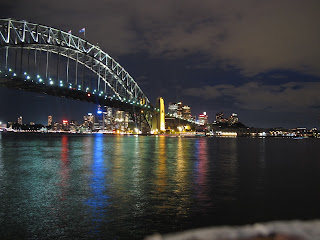
I spent last weekend in Sydney, visiting with a few friends who had never been there before (international students eh, what are they like!). Despite doing and seeing things that I'd mostly done before I still had a good time.  And Sydney was having a light festival called "Vivid" where there are all sorts of lit-up landmarks and art installations around the city, making it a fun place to explore after dark.  Here are some photos:
Sydney harbour, pretty as ever.

Some jellyfish around circular quay

No idea, but fun

Of course, all public art is really just an excuse for a playground.


This staircase was fun.  It lit up only the steps that people were standing on.

Art, not without its pretentiousness, these things have something to do with self and consciousness and stuff.

The Opera House gets in on the act with some great light shows.


The Rocks

More stuff on the Rocks, it certainly made the between pubs part of our evening's drinking more entertaining.

Wednesday, 8 June 2011

Milling

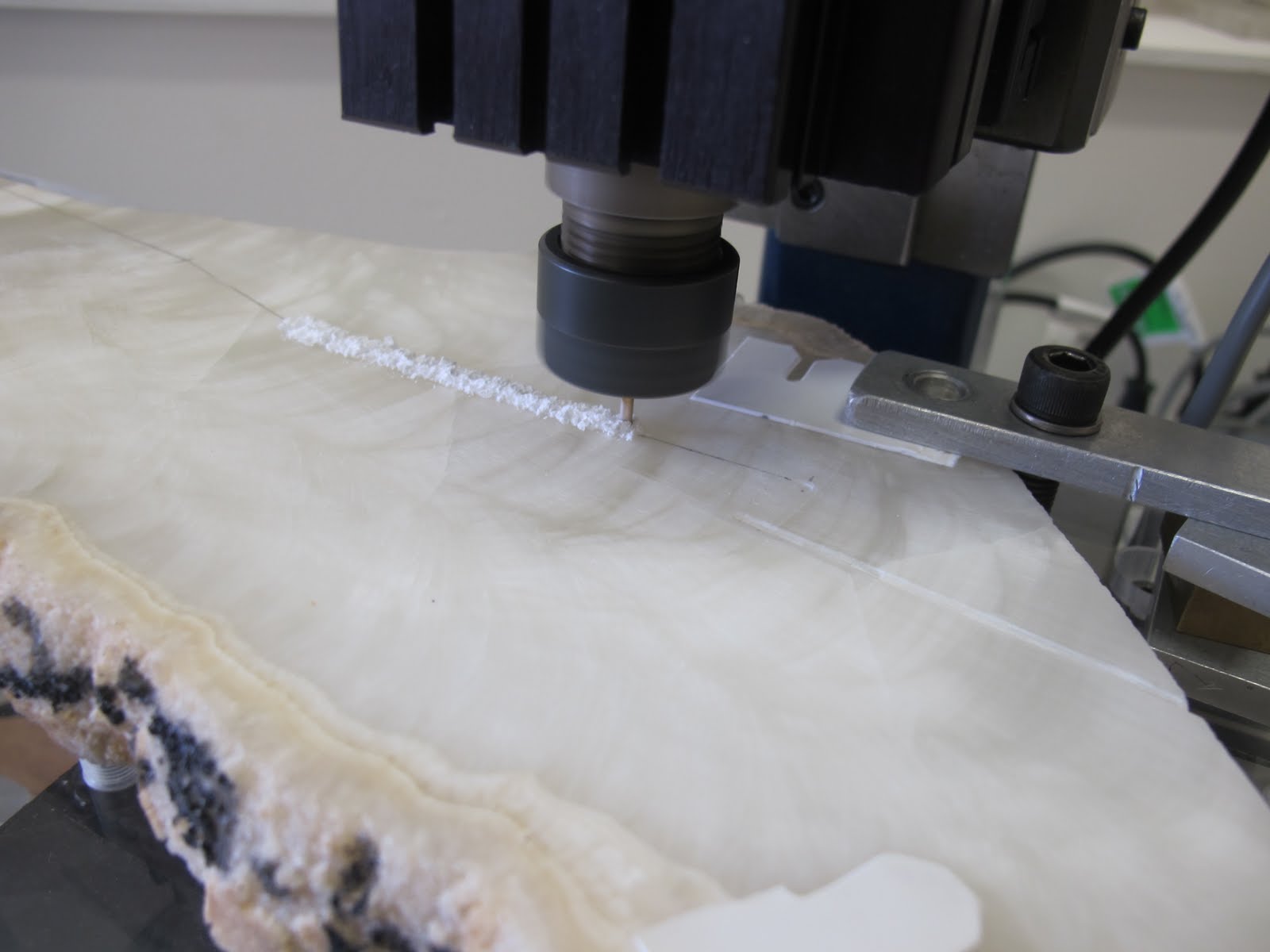
Milling is what I'm going to be doing quite a lot of over the next year. Its the cutting out and collecting of each sample from the stalagmite ready for analysis in the mass spec.


This is the mill. A super-accurate (0.01mm) computer controlled drill. We have two, this is the compact shiny new one which I have set up and am learning how to use. The other is a big bulky thing that we've been using for years.  The old one is good, but it doesn't have good z-control (up/down).


You start by lining up the stalagmite very carefully and clamping it in place. You need to be able to transect across the area you want using just one axis, so the line needs to be perfectly aligned. Then you mill a trench in the material to get rid of surface contaminants and any carbon from the pencil marks on the stal surface.


Now you're ready to go.  By milling in a mm deeper than the trench and slowly inching your way along you slowly cut out a small piece of the stal into a fine powder. Then you collect all the material on a small scalpel and transfer to a vial. Sounds easy, but its really fiddly. Then you clear the cutting area of any loose debris with compressed air so as not to contaminate the next sample, then move on. Repeat, repeat, repeat. Several hundred times! And so on and so on until you've finished your PhD!


Monday, 6 June 2011

Foggy Canberra

Canberra in winter is a cold place.

The bike path to work

 Foggy weather tends to lend itself to black and white photography

It is also a foggy place in the mornings. Fog is Canberra's default state early in winter mornings.  It lasts some mornings more than others and so far this year, its generally been gone before I've got out of the house in the mornings.  But when it does linger it is very pretty.

Part of campus. Black Mountain, which normally looms over the uni, is invisible

The fog also affects the airport as you might expect.  If you're not on the first flight out in the mornings (which is already at the airport overnight so has few issues with landing) then its inadvisable to schedule a flight before 10:30am.

Artsy shot!

Thursday, 2 June 2011

The Stal is ready for its close-up

In a previous installment of "My PhD" I did some arts and crafts cutting out some black masks for some stal photography.  Well I finally have the reflected light photos back.  We also took transmitted light photos where there is a light table on underneath the stalagmite - this makes them look really cool but I'm yet to get these photos back.  We use pretty professional equipment, taking photos at lots of different exposures.  Choosing the right one and then altering contrast and brightness takes a while, especially when there are far better things to be getting on with (not that it was me who was doing the processing).  Hence the slight delay, but the results are pretty pretty!
 

They look a bit weird to me, being used to seeing them in the "flesh".  I guess the contrast is adjusted so that all the layers and features are as visible as possible.


Enjoy!


Sunday, 29 May 2011

Keck

One of the main things we did at the top of Mauan Kea was visit the W.M. Keck Observatories. We were up there as part of a self-drive tour, the guides were pretty damn knowledgeable, lots of interesting info was imparted.
Keck has two telescopes. Which can be used together for judging distances, like how we use two eyes, by processing how the background moves behind the object for the two separate images.  Its known as interferometry, though with my rudimentary knowledge of physics having a baseline of tens of metres for a pair of telescopes seems fairly pointless for the distances required.  For example, the second Gemini telescope is in Chile.  But these guys are probably better physicists than I am, so I trust them that they can make it work.
The inside of the Keck telescope, staring up at the back of the 10m primary mirrors, the second largest optical telescope mirrors in the world. The large primary mirror is actually 36 smaller hexagonal mirrors, each one can be controlled independantly and moved by microns every fraction of a second.  There is some amazing technology going on here. They keep the inside of the observatory refrigerated so that when they open the doors at night, there's no temperature difference. To go with an impressive telescope with impressive technology, there's also some impressive science going on here. At a cost to the user of just $50,000 a night. A snip! As you can imagine there's a long waiting list, for just for a couple of minutes on the telescope.
 The Keck twin telescopes at sunset.
Keck opens up for a night of stargazing.