Showing posts with label Science. Show all posts

Sunday, 12 June 2011

Here's one I made earlier

 
I've been attempting to grow my own calcite.  The reason for doing this is to create whats known as a standard. We dope the calcite with chemicals we want to analyse in other things. Then when we know what the concentration of these chemicals (or elements) are in the calcite (which we get from using other machines) we know how the machine we are measuring our samples on is behaving.  As a result we can quantify our results rather than just say that the machine measures this much of an element. For most things you can buy standards from various companies.  But for some elements in a calcite matrix (the background structure) there is no standard, so you have to make one yourself.

Its been a tricky procedure full of lots of chemistry (remember doing titrations at school, well I was doing them for real - as a scientist - wow!).  Though it has been good fun. It basically involves mixing calcium hydroxide with carbonic acid (which you make by bubbling carbon dioxide through water), plus whatever you want to dope the calcite with.  Simple enough in theory, but when you have to make/mix your own chemicals and then dilute them to the correct concentrations it actually ends up taking all day to do, plus a day beforehand to get hold of all the equipment. And even then it didn't really go too well, no calcite was growing in my beakers.

So the following morning I checked the pH of my solution and found it was far too high, so I threw quantitative chemistry out the window and bubbled more carbon dioxide through the solution until the pH lowered.  And low and behold, after a few more hours back on the stirring plate, calcite was beginning to grow.  Hooray.

Wednesday, 8 June 2011

Milling

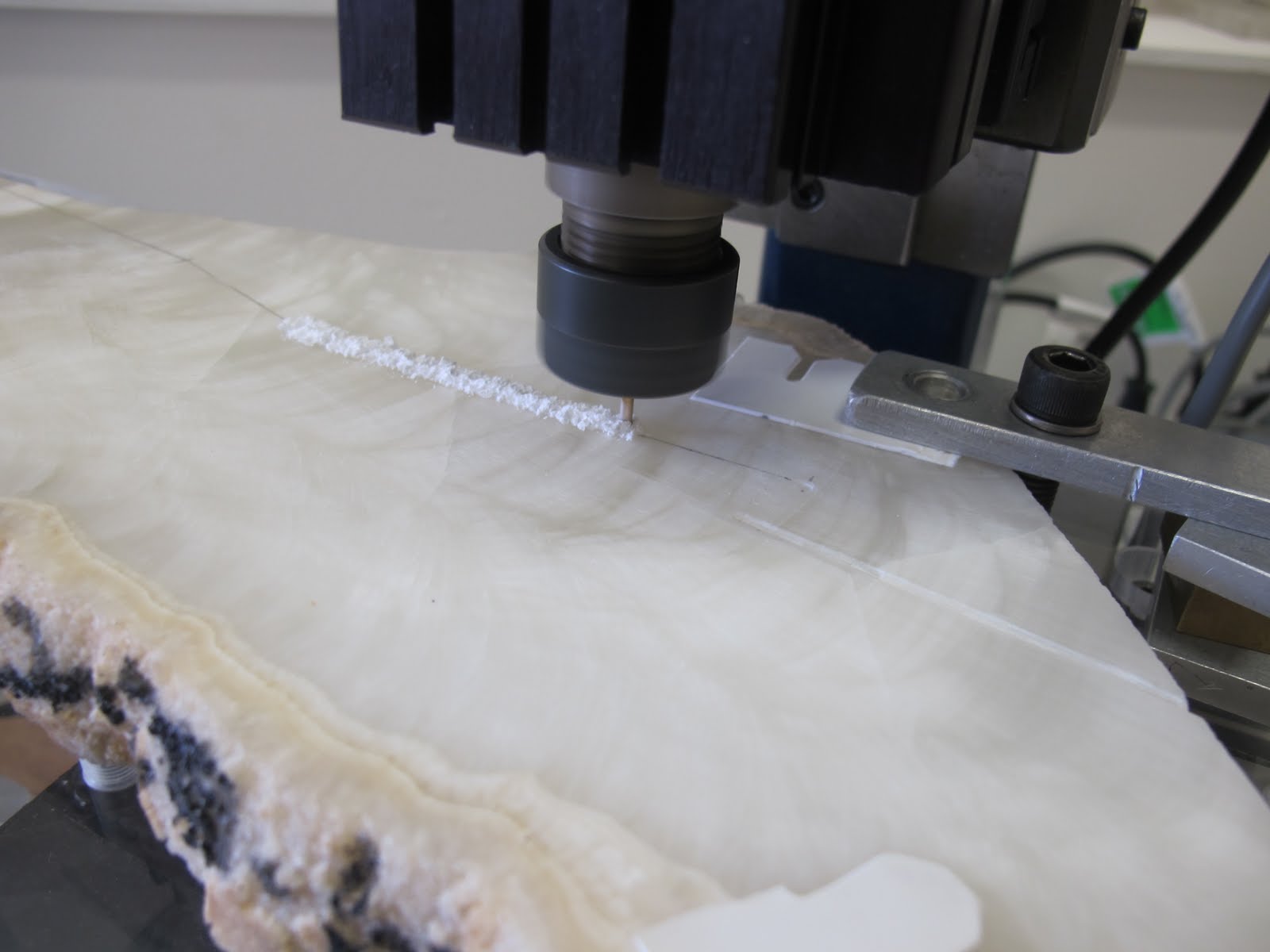
Milling is what I'm going to be doing quite a lot of over the next year. Its the cutting out and collecting of each sample from the stalagmite ready for analysis in the mass spec.


This is the mill. A super-accurate (0.01mm) computer controlled drill. We have two, this is the compact shiny new one which I have set up and am learning how to use. The other is a big bulky thing that we've been using for years.  The old one is good, but it doesn't have good z-control (up/down).


You start by lining up the stalagmite very carefully and clamping it in place. You need to be able to transect across the area you want using just one axis, so the line needs to be perfectly aligned. Then you mill a trench in the material to get rid of surface contaminants and any carbon from the pencil marks on the stal surface.


Now you're ready to go.  By milling in a mm deeper than the trench and slowly inching your way along you slowly cut out a small piece of the stal into a fine powder. Then you collect all the material on a small scalpel and transfer to a vial. Sounds easy, but its really fiddly. Then you clear the cutting area of any loose debris with compressed air so as not to contaminate the next sample, then move on. Repeat, repeat, repeat. Several hundred times! And so on and so on until you've finished your PhD!


Thursday, 2 June 2011

The Stal is ready for its close-up

In a previous installment of "My PhD" I did some arts and crafts cutting out some black masks for some stal photography.  Well I finally have the reflected light photos back.  We also took transmitted light photos where there is a light table on underneath the stalagmite - this makes them look really cool but I'm yet to get these photos back.  We use pretty professional equipment, taking photos at lots of different exposures.  Choosing the right one and then altering contrast and brightness takes a while, especially when there are far better things to be getting on with (not that it was me who was doing the processing).  Hence the slight delay, but the results are pretty pretty!
 

They look a bit weird to me, being used to seeing them in the "flesh".  I guess the contrast is adjusted so that all the layers and features are as visible as possible.


Enjoy!


Sunday, 29 May 2011

Keck

One of the main things we did at the top of Mauan Kea was visit the W.M. Keck Observatories. We were up there as part of a self-drive tour, the guides were pretty damn knowledgeable, lots of interesting info was imparted.
Keck has two telescopes. Which can be used together for judging distances, like how we use two eyes, by processing how the background moves behind the object for the two separate images.  Its known as interferometry, though with my rudimentary knowledge of physics having a baseline of tens of metres for a pair of telescopes seems fairly pointless for the distances required.  For example, the second Gemini telescope is in Chile.  But these guys are probably better physicists than I am, so I trust them that they can make it work.
The inside of the Keck telescope, staring up at the back of the 10m primary mirrors, the second largest optical telescope mirrors in the world. The large primary mirror is actually 36 smaller hexagonal mirrors, each one can be controlled independantly and moved by microns every fraction of a second.  There is some amazing technology going on here. They keep the inside of the observatory refrigerated so that when they open the doors at night, there's no temperature difference. To go with an impressive telescope with impressive technology, there's also some impressive science going on here. At a cost to the user of just $50,000 a night. A snip! As you can imagine there's a long waiting list, for just for a couple of minutes on the telescope.
 The Keck twin telescopes at sunset.
Keck opens up for a night of stargazing.

Tuesday, 24 May 2011

Science, with altitude

Up on the top of Mauna Kea, the highest of the Hawaiian volcanoes theres some rather cool science going on.  With such little light pollution, generally clear skies, and being above a fair amount of the earth's atmosphere, the summit of Mauna Kea is an ideal place for studying the stars, and many of the world's best telescopes are to be found here.  We took a self-drive tour up to the top of the volcano to explore. At 4205m high its pretty damn tall, and we certainly felt the effects of the altitude. Even staying at the visitor's centre at 2800m for over an hour, didn't get rid of the issue, but it certainly helped.


 The UK infrared telescope. Its just looks so British compared to the sleek modern domes that surround it.


We went for a short walk that was very slow due to the altitude up to the actual summit, away from the telescopes. There was occasionally the reminder that this is indeed still a volcano, albeit now a dormant one. The top of the volcano is sacred to native Hawaiians and so there is often much debate as to how much presence the telescopes should have on top of the mountain. Its a very complicated issue and certainly not as straightforward as just the scientists moving into a sacred area.  The Hawaiians didn't care until their recent cultural awakening, though perhaps the scientists could have been more sensitive. Hawaiian culture is based on stargazing and navigation, so is this modern science just an extension of Hawaii's heritage.

We stayed up after the tour had finished (along with most people on it) to watch the sunset from the top.  It was spectacular.

 The Subaru telescope opens up at sunset.

 The Gemini telescope opens up for the night. The other one is in Chile. (Putting your telescopes far apart enables you to get a better idea of distances, just like having two eyes)

 The UK infrared telescope, along with a small horde of tourists up watching the sunset.

A nice view on the way down.  They force you off the top of the mountain pretty quickly after sunset so that the scientists can get to work. Headlights can really screw up their observations.

Saturn, viewed through a telescope.

But there's time for some stargazing back down at the visitor's centre.  In fact, due to the lack of oxygen at the mountain's summit the brain doesn't work so well at altitude.  Therefore the best place to view stars with the naked eye is at the visitor's centre, where they have viewings at the weekends (I'm guessing its still possible to "view" the stars during the week, but they have local amateur astronomers with their telescopes there at weekends and hot chocolate and the like!). Even if one of the guides giving a night sky talk was a little crazy with his science, the stars were incredible. Just so beautiful, and we got a good look at a planet or two through some of the telescopes. Pretty damn good!

Wednesday, 27 April 2011

Stal Update: More arts and crafts

 *sigh*.  Its been slow progress over the past month on the PhD front.  What with the MAT 251 breaking down, the results from dating taking forever (we outsource to another uni who do it near constantly), the PhD is crawling slowly slowly along.  The next step in the journey of the stalagmite from cave to paper is that it needs to be marked up and a decision taken as to where exactly we need to drill into the stal to get our results from.

 The stal known as "crusty" is marked up ready for drilling.

We want to get our results from as close to the middle of the stal as possible. Thats why we cut slabs out of them to get to the middle, with the slab direction chosen so that the central growth axis  of the stal where we want to measure can move (as they tend to do with changing drips) whilst still allowing us to access it.  First we chose the side of the slab which we believe is closest to the centre of the stal for the longest duration and that has nice banding.  Then we draw a line up the centre of the stal, keeping it roughly midway through the flat parallel layers that define the centre of the stal rather than the sloping edges.  And ideally we draw perpendicular to the growth layers to get better sample resolution and less overlap between samples.

Because the growth axis moves around over time (you wouldn't expect a drip from the ceiling of the cave to stay exactly in the same place for tens of thousands of years) this involves stopping the lines, changing angles and shifting left and right as appropriate, but ideally as little as possible to avoid any unwanted changes in isotopes that can sometimes result.  Plus we need to shift the lines near the edge of each slab so that we have overlap between the slabs and can therefore overlap our results and make sure they line up perfectly, rather than guessing! It takes a little while longer than just drawing lines would first suggest.

Next time: drilling our samples! (which will hopefully happen sometime in May if we get the new drilling machine up and running).
A close up of one of the lower slabs of crusty

Saturday, 23 April 2011

MAT 251

So this is the latest machine I'm working on: The MAT 251

Isn't it great! Its an old mass spec and has all sorts of toggles and switches and push buttons to make it work.  Its brilliantly retro and when it works, it works like a treat. It is a carbonate mass spectrometer.  Carbonate samples (like stalagmite powders) 200mg in weight are put in vials.  Phosphoric acid is added and the resultant carbon dioxide gas is sent through the mass spectrometer and the proportions of each masses are recorded to give nice and shiny oxygen and carbon isotope ratios.  Or random numbers, depending on its mood.

Not that it works that often. Its been broken on and off for a long time. Its starting to run out of legs. In the last month or so its hardly run at all after a series of faults. We have a new machine waiting in the wings, the shiny, the new, the imaginatively named MAT 253, but we've yet to get it up and running (for reasons which thoroughly perplex and frequently annoy me!).  So we're stuck with this aging beauty and her temper for a little while longer.

The MAT 251 and the new 253 will run the vast majority of the analyses I will run over the course of my PhD.  Its the bread and butter of my PhD if you will.

Tuesday, 15 March 2011

Scientific Communication

I attended a workshop this week in scientific communication. It was fascinating and involved pieces on talking to the public, talking to peers, and talking to the media. Its amazing how much scientists expect the general public to take an interest in their work and expect them to do the legwork to get to even a basic understanding of what we as scientists believe should be obvious knowledge (what causes the seasons for example).  In fact, this is exactly the arrogant point of view that the public finds turns them off science.  It is up to the scientists to communicate their work in an effective manner.

And its not that difficult to do.  Its not about dumbing down, we shouldn't dilute the concepts.  The public can handle challenging ideas.  Its about how its put across. Short sentences, no jargon, and as few a words with three syllables or more (whats known as a low fog index).  And this needs to be done by the scientists, who know their work better than anyone else, and are more enthusiastic about their work than anyone else.  If they can transfer just some of this to the public in an effective manner then this is how the public will become better informed.

I couldn't find the video clip but take a look at this transcript: http://www.abc.net.au/tv/enoughrope/transcripts/s1453920.htm
Towards the top there is a fantastic explanation (it works better visually with props) of the Transplantational Molecules work that won Professor Peter Doherty the Nobel Prize. Complex science I'm sure you agree, easy as anything once its been explaned by an ethusiastic man with a bowl of fruit. Its a good explanantion, even without the visuals.

Later on during the week, I've been asked to think about writing a press release for my first paper which will be out in a couple of months (Its now In Press, which is exciting!).  I thought the timing was excellent, and I definitely now have the skills to give it a really good go.

And so to my little rant for the day.  I'm all for scientific terminology being used in common parlance.  Everyone (well, some people, lets not be an arrogant scientists here) understands what some scientific phrases mean when applied to non-scientific situations. But when that phrase is used in the common usage in the situation where it could also happen in the scientific sense then it becomes annoying and a bit stupid.  Two examples from the Australian press this week when talking about the Japanese earthquake and the consequences thereof.

The first from the Sydney Morning Herald: "Aftershocks to be felt around the world" - Erm no.  They won't be, the aftershocks will be felt in Japan.  I understand that using aftershocks to imply that an event will set off a chain of further events that may have  far-reaching consequences is common, and it makes some sense.  But you can't use this word when there will actually be aftershocks.

*Just been watching the very good George Neegus, one of Australia's best journalists, he just mentioned aftershocks in relationship to the financial markets, but used the phrase "aftershocks of a different kind".  Well done to him.

The second was referring to fallout from the quake. Again, a phrase which is relatively easy to understand in the context in which it was put. However, when there is a genuine risk of fallout from a nuclear disaster, this reference is misleading, wrong and frankly stupid.

*ugh, Channel Ten news just did it again.

Two of my geologist cohort went on to further degrees in the world of writing, one as a journalist and one as a publisher. And good luck to them. But overall, when the journalism profession is mostly composed and run by people with arts degrees such mistakes are likely to go un-noticed. The world needs more journalists with science degrees. And more scientists to communicate their work efficiently and well to the public. And the responsibility for this lies not with the journalism profession but with science in general and scientists. We must make ourselves and our work more well-known, not expect the general public to do the leg-work to understand us.

Thursday, 10 March 2011

The Stal behind the mask

Next stage in the journey of my stalagmites is photographing them.  Having finished the polishing to make them look shiny we now get to the stage of photographing them.  This is useful for working out where things have to be done, where things have been done, to check where things were before we drilled or milled them away and to correlate between different records using different machines on parallel tracks up the centre of the stalagmite. But before we get to the photography we need to dress our stals up!  By giving them masks.
To produce good photographs in really good detail the stal needs to take centre stage. So we photograph them on a black card background.  We photograph the stals in two ways.  The first is obvious, reflected light, by shining bright lights onto the top surface of the stalagmite.  The second is a bit more cunning.  These slabs of stalgmite are typically about 2cm thick, so they let light through them. If we place them on a light table and shine light from underneath then you get a whole new perspective on whats inside.  You really get to see the inside structure.  But obviously light doesn't travel through black card and if we photographed them on the light table then the light from the table would drown out the light through the stal.
So I have to trace round each stalagmite piece, and then cut round a few millimetres inside the trace to create a mask that the stal sits ontop of.  Very crafty! The light comes through the stal and it all looks rather pretty.  Photos soon.

Wednesday, 19 January 2011

Stal Polishing

Previously on "My PhD", we went to Tumut to get several stalagmites cut.  Then we drilled little pieces out to analyse them on the Krystalloflex to check whether they were calcite or aragonite and also sent some samples off to be dated.  Over these couple of weeks I'm spending a few afternoons polishing the slabs we cut out the middle of the stalagmites.  This involves a polishing device which rotates different grade polishing things (or some such technical explanation, its late and I'm tired).  Its attached to a hose so fires high pressure water at the same time in that water and electricity mix that makes me nervous.  There are seven grades of polishing to get the slabs level and get rid of bumps and scratches and then to polish so that they are nice and smooth, and shiny even when dry.  It takes ages.  These three pieces took two and a half hours to polish both sides.  Its quite tiring because the machine is uncomfortable to use and the hose isn't that well connected so it occasionally comes off and sprays me in the face and gets me soaking wet.
 This is what the stal slabs look like before:
And this is what the stal looks life afterwards.  Actually it doesn't look much better in these pics I'll admit.  But it really is easier to see all the deatils, theres contrast and the layers are much sharper, and you can see more sub mm structures.  All of this is very good.
So we now can analyse the stal structure in more detail, we can tell better where things are going on such as changes in structure, hiatuses in stalagmite growth.  Having a level smooth slab also makes it easier to drill consistent powders down the middle when we get to that stage.  What I need now are some dates so I can work out exactly which of the collected stalagmites I need to use.  Unfortunatly this bit is outsourced to Melbourne. And so we wait.

Thursday, 13 January 2011

Brisbane Underwater

This is a news story that has been across the world over the past couple of days so I won't go over the details apart from an interesting fact:

The area of Queensland underwater is bigger than France and Germany, thats a lot of water.

I've had my first scientific paper accepted for publication (subject to a major revision of course), which, as its on the subject of the El Nino-Southern Oscillation (ENSO) now makes me qualified to talk about the flooding on a scientific level.  I went over the fact we're in a La Nina year in a previous post on the rain in Canberra at the start of December and the flooding in Queensland is an extension of that.  Rainfall in Australia should return to normal levels by April.

However I focused on sea surface temperatures, which, as this very interesting article discusses, may not be the whole story: http://www.abc.net.au/unleashed/42858.html
The strength of a La Nina is typically measured by the sea-surface temperature in the eastern equatorial Pacific which as this page demonstrates (http://ggweather.com/enso/oni.htm), is lower than we've had it for a reasonable but not a long time. However as the planet is warming up the baseline of temperatures is rising. Thus the absolute temperature may not be drastically low, but the anomaly may be larger than it appears as its dropping from a now higher baseline.  Thus it is the ocean pressures (the southern oscillation part of ENSO, typically measured as the air pressure difference between Tahiti and Darwin) which reveal that this year may actually be a big big event, the biggest since 1917 (http://www.bom.gov.au/climate/current/soihtm1.shtml), as these are recording a much larger anomaly, and help control the actual weather that this climatic phenomenon tends to cause.  This is the kind of thing I find interesting! (Although I feel that those people writing the comments section ought to be shot for stupidity, the article is hardly about global warming, the fact we have a strong La Nina has nothing (probably) to do with the changing climate, its just how we measure it that we're having to adapt (surely proof in itself that the climate is getting hotter if we're having to change how we measure things to cope)  Grrrr!)

Of course its not just Queensland underwater.  The second major story on the news tonight was the floods in Victoria, the third was flooding in Tasmania, and the fourth was flooding in New South Wales.  The floods in Brazil came in about eighth!

Saturday, 8 January 2011

A department divided

One thing that was apparent at the department christmas do just before the break was the number of people that I didn't recognise.  The hidden half of the department emerged.  And I heard lots of people saying the same thing. As someone who is pretty much always at the departmental seminars, beer and nibbles, and makes it to morning coffee at least once a week I don't think its my fault, it's theirs!
The problem, at least in part lies in the division of the department on two sites (though this doesn't fully explain everybody).  Historically, when the university was first set up many of the subjects were split into a research section (research school) and a section (department), so that those who didn't want to teach didn't have to. The teaching section continued to do some research though.  It lead to a few quirks, not all universities have an experimental petrology group, we had two, working completly independantly in what was effectively two departments.  This of course, is rather silly, so the two sections were united a few years back into one body. But having two buildings, especially when they're reasonably far apart, has created a bit of a them and us approach.  As part of the environmental section of the department, we're especially split between the two buildings, other groups are less so.  LB, one of my best friends in the department is down the hill in the "other" department. But its also the case that the honours students (equivalent of an undergrad masters in Oxford) are also a bit isolated from the hustle and bustle of the larger research school.  However, there are some positives, given that the first year scientists are not yet tied to a department, keeping teaching space close to the other sciences and the undergrad halls certainly increases footfall.
 This is about to change though, with the destruction of one of the buildings which no-one really used anyway (it was old and basically a tin-shed) and the creation of a brand-spanking new 9th building (we have quite a few!) which will contain lecture facilities, undergrad teaching space and office and lab space.  The department will eventually become one on a single site and hopefully the integration will be a little better.
Apparently they want to build this place within a year, erm, really?? I know the old building didn't have foundations so the site was cleared very quicky, but still.  Good luck to them!

Wednesday, 15 December 2010

Chemistry Set

This week is kind of my first crucial week of my PhD. Not because anything much depends on the results I get out (in a pure data sense) but rather this week's experiments will define what exactly I'm doing for my PhD. All of my pilot studies are coming to fruition and a close at the same time! In one of those quirks of timing I've ended up with a lot of machine time over the course of this week. First up is the MAT251, our group's ageing mass spec which runs some carbon and oxygen isotopes in a fairly standard way, nothing too special about the instrument, but the particular piece of time we're looking at is pretty damn cool.  On Friday I'm back on the laser, this time attached to a different mass spec called the Neptune, trying to do things that mass specs have never done before. And on Monday I have another day on the Shrimp, trying to find out whether I can link two strands of my PhD (the MAT251 part and the Laser-Neptune) into one!

In the middle of this is three days spent playing with a Chemistry set (a real one!) and another mass spec. I'm going to have to be vague here as the work I'm attempting here has only once been tried before in an unpublished piece of work in this department and obviously I'd rather not get scooped if it turns out to work.  Anyway it involves lots of dissolving of my samples in acid, then playing with more chemicals to extract the solute, and all of it has to be done without any contamination, which involves a lot of washing things with yet more chemicals.  Its all a bit fiddly but if it works then it may well be really interesting.

So, by the end of next week, once I've managed to have a look at the results properly, I'll hopefully have worked out which parts of what I want to do work, and which ones don't.  Then I can plan ahead and really get going with the actual work!

Wednesday, 1 December 2010

Eden

So I've spent the last week down on the coast around the town of Eden, close to the New South Wales/Victoria border (about three to four hours drive from Canberra, five taking the long route).  I was demonstrating on the first-year undergraduate field-course.  It was a lot of fun.  It was sunny all week, and warm, we spent most of it by the coast, frequently on nice beaches, a few swims in the ocean (much much warmer than a month ago!) and there were lots of interesting rocks.  But not too complicated, just difficult enough for me to work it out pretty quickly and the undergrads to puzzle over for a while! Plus there was some not so excellent, followed by excellent, followed by not so excellent followed by excellent cricket going on!


There were three of us postgrads demonstrating (myself, EG and BH - both of whom I get along very well with) along with a plethora of some big names in geology, which was rather cool. One thing that was disappointing was the undergrads reluctance to drink.  Having a beer or two during the evening session's lectures and work is pretty standard for geologists.  These kids need to learn! They were a good bunch really!


We finished the week by driving back up the coast for a beach party to celebrate LB's (another departmental first year grad) birthday.  And a good time was had by all. In the morning it decided to rain, so we fled back to Canberra, where it genuinely hasn't stopped raining since.  Its meant to be summer now.  Sigh!

Loads of photos, enjoy!