Showing posts with label Travel. Show all posts

Saturday, 16 July 2011

Yes, we have no bananas

In field-food has a tendency to become very repetitive, especially when it’s the same thing everyday. Because cave work is so hot and sweaty and the caves are dark and humid and often muddy you never really feel like eating anything. But the energy is needed and snacking always helps give you a blood sugar boost in the cave. Our in-cave food consists mostly of Pokari Sweat, an isotonic drink that I believe is Japanese, and SilverQueen, a brand of chocolate bar. The Pokari Sweat is excellent because drinking just water isn’t enough in the caves to give you energy back and replacing lost salts when in the tropics and doing hard work is obviously a very good idea. Plus its not too sweet. As for the SilverQueen, we try for the dark chocolate variety, partly because it has a slightly higher melting point than the other ones, and partly because when you’re in a muddy cave, the dark chocolate hides the dirt the best.


One food that never travels particularly well is the humble banana. So you can imagine that in a situation where there are big packs with everything loose inside being banged against rocks and hauled up pitches that bananas would not necessarily be the cavers’ fruit of choice. And yet we haul in quite a few bananas. Being the tropical variety they are the very small ones which you can eat in two mouthfuls, or one if you feel like showing off, and not too sweet. Very tasty but not very practical.

Thursday, 14 July 2011

Bintang Beer

Ahh, Bintang Beer, Indonesia’s local brew. For the first half of our trip we’re in southern Sulawesi, which is quite a conservatively Muslim area and so drinking is fairly unheard of round these parts, at least for Indonesians. Still being a fairly tolerant bunch, westerners aren’t expected to comply and it’s fairly easy to buy. Of course, public drunkenness is still very much frowned upon and since the owner of our accommodation is quite a devout Muslim, a Hajji we don’t drink at our place. We are therefore generally forgoing the post-field beer (which is a travesty for any self-respecting geologist) except when discussing goings on with the village patriarch who some people visit on the occasional evening before dinner. The second half of the trip will be spent on a catholic island though, so I expect there will be more drinking there. Meanwhile, in the port area of Makassar, the nearest major city where we’ve spent a day or two it’s possible to buy a couple of bottles, and sit and watch the sun set over the Celebes Sea. Perfect.

Monday, 20 June 2011

Taking a step back, and a few steps around the big durian


I feel I may have been too tough on Jakarta from what I've seen so far.  It is a South-east asian city and has some of the features of south-east asian cities that I like such as the chaotic roads, imposssibly shiny floors, narrow staircases and the faint smell of durian. So in our final day in Jakarta, known as "The Big Durian" I headed off to the old part of town, Kota, also known as Batavia (twas a Dutch colony), to see if this city could be redeemed by actually going and having a look at the more interesting things, rather than just the traffic, noise and pollution.

An old Dutch colonial building

The answer is somewhat.  Jakarta remains noisy dirty and polluted and even Kota was a dirty place. It had some character, but not loads compared to other comparable cities (Hanoi, Ho Chi Minh, Kota Kinabalu, Bandarseribagawan being my main reference points). The main square was nice-enough, the port interesting enough, but there was no real wow factor.  Jakarta may be a great place to shop and to go clubbing and to feel the pulse of real Indonesia, but its not really a city with sights, and things to go and do and see. The old town was falling apart, not just at the edges, bur right in the middle too.

Bikes with hats

An old drawbridge, above a really dirty, stinky, gas releasing canal

Boats in the harbour

Lined up

We visited the port that formed the northern end of Kota.  It was an interesting place with all these boats, quite large, being loaded up with either bags of rice or bags of cement, often by hand, often by little cranes built into each boat. It was good fun to watch.

Loading cement bags by hand

"Five-legged creatures" - What food carts are known as in Jakarta

Treating ourselves to some fancy drinks in the fancy joint in town. A colonial/art deco mix of  a building with dark wood, and photos of movie stars hanging on the walls.

Off on real fieldwork tomorrow (a few days ago when this gets published), who knows how good the internet connection will be and when I'll next be posting more of my Indonesian adventures!

Saturday, 18 June 2011

Up in the haze


Up in the hills in the centre of Java, two to three hours out of Jakarta, through rice paddies and fruit trees lies the city of Bandung. Its much nicer than Jakarta, though its still hazy and polluted (whether this is self-generated or just gets blown in from Jakarta down below I don't know, probably a bit of both).  There are more trees though, which makes it better. Bandung is the home of LIPI, the Indonesian Centre for Sciences (or similar translation of the acronym) and where our Indonesian contacts work. Its also where we store a lot of gear for fieldwork. So we took the trip up to LIPI to sort through the field-gear, through some things away, check what we had and prepare everything for shipping to the field-sites.  This field-work has a lot of equipment I can tell you that!

An interesting bridge for all you engineers out there - the arch is upside-down!

 The Geoteknologi Department

Once the gear was sorted we took an excursion to the top of a mountain, which was shut due to clouds, despite the trees looking all misty and atmospheric and rather cool. So we went to the local waterfalls, which were interesting, but not particularly nice. They smelt a bit funny, were a bit too foamy and the water was just the wrong colour. Even up here, this part of the world is polluted.  And its a shame because otherwise this place might have been quite pretty.
Well, pretty if they also got rid of all the concrete structures around the place too which made the whole area look not unlike a badly designed Rivendell.

Just not the colour waterfalls should be if they desire to be in the picturesque category

Nice-ish

Not that the place was all bad, the two restaurants we visited for lunch and dinner were very good.  Proper Indonesian fare. Very tasty. And there was a thunderstorm on the way back, which did help clear the air somewhat.

Thursday, 16 June 2011

Jakarta: Where the air is as thick as the pile of paperwork

Jakarta is a big, polluted, hazy, concretey, endless sprawl of a city.  A bit like Los Angeles. The city has a population of 9.5 million.  Take into account the Greater Jakarta area (ie. the suburbs and commuter belts) and the population jumps to 28 million, making it the second biggest city in the world (or fourth, depending on how you count). It's polluted, the sky is very hazy and the roads are constantly packed.

We’re in Jakarta at the start of our fieldwork.  This is because the Indonesians love their paperwork. There are lots of forms to fill out, stamps to get hold of, and queues to be queued in.  And it has been taking us days to get sorted so we can actually fly out and begin fieldwork. We reckoits not realy whats on he forms thats important, its about having the right forms.  There's no way that anyone has the time to look at all of the forms for everybody that passes through the immigration office. We’ve been having meetings, travelling to Immigration offices (there are eight of them), getting hold of permits in order to go and do our fieldwork, and sorting out all of the equipment we need to take with us.  Much of our time has been spent in taxis in the endless traffic jams in this endless city so this photo seems pretty appropriate. I don’t really have many others as we’ve been busy and not really touristing around much. A thirty minute PhD, I wish!


The roads are reasonably chaotic, but as nobody is travelling particularly fast, its more jostling for position, and therefore the whole thing doesn’t really feel that dangerous. Lots of motorbikes and scooters, but not as many as, say, Hanoi.  Perhaps this is because Indonesia is a more affluent country and so more people can afford cars.  I dare say the city would go more quickly with more bikes and fewer cars.  But then again, a decent public transport system wouldn’t go amiss either!

Tuesday, 14 June 2011

Looking forward to bananas (amongst other things)

Hi everyone,

I'm away on fieldwork for the next six weeks (in fact I left on Sunday but had a couple of posts to make so put them in a queue for a while). There may or may not be regular or fast enough internet access to post too many times, but there will be lots of cool photos being taken, and lots of awesome geologising to be done.

Looking forward to bananas that don't cost $12 a kilo. Stupid Australian protectionist policies coupled with cyclone damage in Queensland has meant there are no bananas in this country.

Hooray fieldwork! I'm so excited!

Saturday, 11 June 2011

A light show on the Rocks

I do like Sydney, it really is a very nice city. In fact I'd say its biggest fault is that it knows its so good and goes around flaunting it. In that kind of way that makes you want to dislike it. So much so that I enjoy telling people that Sydney's annual rainfall is approximately twice that of London, with 37 more rainy days per year.

I spent last weekend in Sydney, visiting with a few friends who had never been there before (international students eh, what are they like!). Despite doing and seeing things that I'd mostly done before I still had a good time.  And Sydney was having a light festival called "Vivid" where there are all sorts of lit-up landmarks and art installations around the city, making it a fun place to explore after dark.  Here are some photos:
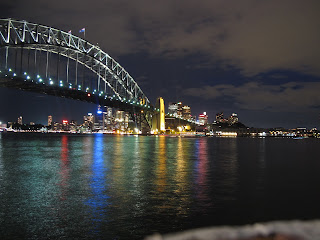
Sydney harbour, pretty as ever.

Some jellyfish around circular quay

No idea, but fun

Of course, all public art is really just an excuse for a playground.


This staircase was fun.  It lit up only the steps that people were standing on.

Art, not without its pretentiousness, these things have something to do with self and consciousness and stuff.

The Opera House gets in on the act with some great light shows.


The Rocks

More stuff on the Rocks, it certainly made the between pubs part of our evening's drinking more entertaining.

Sunday, 29 May 2011

Keck

One of the main things we did at the top of Mauan Kea was visit the W.M. Keck Observatories. We were up there as part of a self-drive tour, the guides were pretty damn knowledgeable, lots of interesting info was imparted.
Keck has two telescopes. Which can be used together for judging distances, like how we use two eyes, by processing how the background moves behind the object for the two separate images.  Its known as interferometry, though with my rudimentary knowledge of physics having a baseline of tens of metres for a pair of telescopes seems fairly pointless for the distances required.  For example, the second Gemini telescope is in Chile.  But these guys are probably better physicists than I am, so I trust them that they can make it work.
The inside of the Keck telescope, staring up at the back of the 10m primary mirrors, the second largest optical telescope mirrors in the world. The large primary mirror is actually 36 smaller hexagonal mirrors, each one can be controlled independantly and moved by microns every fraction of a second.  There is some amazing technology going on here. They keep the inside of the observatory refrigerated so that when they open the doors at night, there's no temperature difference. To go with an impressive telescope with impressive technology, there's also some impressive science going on here. At a cost to the user of just $50,000 a night. A snip! As you can imagine there's a long waiting list, for just for a couple of minutes on the telescope.
 The Keck twin telescopes at sunset.
Keck opens up for a night of stargazing.

Tuesday, 24 May 2011

Science, with altitude

Up on the top of Mauna Kea, the highest of the Hawaiian volcanoes theres some rather cool science going on.  With such little light pollution, generally clear skies, and being above a fair amount of the earth's atmosphere, the summit of Mauna Kea is an ideal place for studying the stars, and many of the world's best telescopes are to be found here.  We took a self-drive tour up to the top of the volcano to explore. At 4205m high its pretty damn tall, and we certainly felt the effects of the altitude. Even staying at the visitor's centre at 2800m for over an hour, didn't get rid of the issue, but it certainly helped.


 The UK infrared telescope. Its just looks so British compared to the sleek modern domes that surround it.


We went for a short walk that was very slow due to the altitude up to the actual summit, away from the telescopes. There was occasionally the reminder that this is indeed still a volcano, albeit now a dormant one. The top of the volcano is sacred to native Hawaiians and so there is often much debate as to how much presence the telescopes should have on top of the mountain. Its a very complicated issue and certainly not as straightforward as just the scientists moving into a sacred area.  The Hawaiians didn't care until their recent cultural awakening, though perhaps the scientists could have been more sensitive. Hawaiian culture is based on stargazing and navigation, so is this modern science just an extension of Hawaii's heritage.

We stayed up after the tour had finished (along with most people on it) to watch the sunset from the top.  It was spectacular.

 The Subaru telescope opens up at sunset.

 The Gemini telescope opens up for the night. The other one is in Chile. (Putting your telescopes far apart enables you to get a better idea of distances, just like having two eyes)

 The UK infrared telescope, along with a small horde of tourists up watching the sunset.

A nice view on the way down.  They force you off the top of the mountain pretty quickly after sunset so that the scientists can get to work. Headlights can really screw up their observations.

Saturn, viewed through a telescope.

But there's time for some stargazing back down at the visitor's centre.  In fact, due to the lack of oxygen at the mountain's summit the brain doesn't work so well at altitude.  Therefore the best place to view stars with the naked eye is at the visitor's centre, where they have viewings at the weekends (I'm guessing its still possible to "view" the stars during the week, but they have local amateur astronomers with their telescopes there at weekends and hot chocolate and the like!). Even if one of the guides giving a night sky talk was a little crazy with his science, the stars were incredible. Just so beautiful, and we got a good look at a planet or two through some of the telescopes. Pretty damn good!

Sunday, 22 May 2011

Where there's smoke...

Of course, Kilauea isn't just a volcano that erupted recently, its a volcano that is erupting.  The most active volcano on the planet is erupting near constantly. Just not quite as much as normal when we were there.  Normally there is one crater down on the East Rift Zone that you can see a lava lake, and a fissure that opens up near the sea where the lava pours into the ocean. Very photogenic stuff and great for tourism.  But Pele (A Hawaiian goddess who's nominally in charge of volcanoes and fire, not that the Hawaiian gods and goddesses are gods of anything the way the Greek and Roman ones were) is her own master and isn't always obliging.  Occasionally obliterating villages and destroying roads and occasionally not doing very much at all.  In early March, there was a burst of activity, which saw a small collapse in the East Rift Zone, the lava lake shrank back into the volcanic vent and the far eastern fissure stopped erupting.  So there was nowhere to watch lava whilst we were there.  A bit disappointing but still...
It is an active volcano, and active volcanoes do tend to smoke a bit, even if there isn't lava coming out. Which is still pretty damn cool.  An boy does Kilauea smoke.  There's been elevated sulphur dioxide levels in the National Park for a couple of years, indicating that something is going on. Half of the park (luckily the more boring half) is closed to visitors.
This is the view across, the small side crater at Kilauea, with the big one stretching off into the distance.

Then at the end of the day, after cycling around the park, we took a quick drive round to the other side of the crater/caldera in the fading light.  In the photo above, the circular thing is the crater. Pretty much everything in shot is the caldera, its about 3x5km. With smoke rising up above, and as darkness fell, we got an unexpected treat.
Whilst you might not be able to see the lava (its a couple of hundred metres below the surface in the vent), you can see the glow of the lava, bouncing off the smoke plume. Its so awesome! And as it gets darker (and colder!) the light gets brighter.  Luckily there's a pretty damn good museum on the caldera rim (along with the Hawaiian Volcano Observatory) to keep warm and entertained in between just standing outside and watching the amazing glow. A little view into the earth's interior (kind of).

Plus, as a little aside, the flanks of Mauna Loa, which sits above Kilaeua, have started expanding.  Something is brewing under big island and its probably magma!