This is a news story that has been across the world over the past couple of days so I won't go over the details apart from an interesting fact:
The area of Queensland underwater is bigger than France and Germany, thats a lot of water.
I've had my first scientific paper accepted for publication (subject to a major revision of course), which, as its on the subject of the El Nino-Southern Oscillation (ENSO) now makes me qualified to talk about the flooding on a scientific level. I went over the fact we're in a La Nina year in a previous post on the rain in Canberra at the start of December and the flooding in Queensland is an extension of that. Rainfall in Australia should return to normal levels by April.
However I focused on sea surface temperatures, which, as this very interesting article discusses, may not be the whole story: http://www.abc.net.au/unleashed/42858.html
The strength of a La Nina is typically measured by the sea-surface temperature in the eastern equatorial Pacific which as this page demonstrates (http://ggweather.com/enso/oni.htm), is lower than we've had it for a reasonable but not a long time. However as the planet is warming up the baseline of temperatures is rising. Thus the absolute temperature may not be drastically low, but the anomaly may be larger than it appears as its dropping from a now higher baseline. Thus it is the ocean pressures (the southern oscillation part of ENSO, typically measured as the air pressure difference between Tahiti and Darwin) which reveal that this year may actually be a big big event, the biggest since 1917 (http://www.bom.gov.au/climate/current/soihtm1.shtml), as these are recording a much larger anomaly, and help control the actual weather that this climatic phenomenon tends to cause. This is the kind of thing I find interesting! (Although I feel that those people writing the comments section ought to be shot for stupidity, the article is hardly about global warming, the fact we have a strong La Nina has nothing (probably) to do with the changing climate, its just how we measure it that we're having to adapt (surely proof in itself that the climate is getting hotter if we're having to change how we measure things to cope) Grrrr!)
Of course its not just Queensland underwater. The second major story on the news tonight was the floods in Victoria, the third was flooding in Tasmania, and the fourth was flooding in New South Wales. The floods in Brazil came in about eighth!
Thursday, 13 January 2011

Saturday, 8 January 2011
A department divided
One thing that was apparent at the department christmas do just before the break was the number of people that I didn't recognise. The hidden half of the department emerged. And I heard lots of people saying the same thing. As someone who is pretty much always at the departmental seminars, beer and nibbles, and makes it to morning coffee at least once a week I don't think its my fault, it's theirs!
The problem, at least in part lies in the division of the department on two sites (though this doesn't fully explain everybody). Historically, when the university was first set up many of the subjects were split into a research section (research school) and a section (department), so that those who didn't want to teach didn't have to. The teaching section continued to do some research though. It lead to a few quirks, not all universities have an experimental petrology group, we had two, working completly independantly in what was effectively two departments. This of course, is rather silly, so the two sections were united a few years back into one body. But having two buildings, especially when they're reasonably far apart, has created a bit of a them and us approach. As part of the environmental section of the department, we're especially split between the two buildings, other groups are less so. LB, one of my best friends in the department is down the hill in the "other" department. But its also the case that the honours students (equivalent of an undergrad masters in Oxford) are also a bit isolated from the hustle and bustle of the larger research school. However, there are some positives, given that the first year scientists are not yet tied to a department, keeping teaching space close to the other sciences and the undergrad halls certainly increases footfall.
 This is about to change though, with the destruction of one of the buildings which no-one really used anyway (it was old and basically a tin-shed) and the creation of a brand-spanking new 9th building (we have quite a few!) which will contain lecture facilities, undergrad teaching space and office and lab space. The department will eventually become one on a single site and hopefully the integration will be a little better.
 Apparently they want to build this place within a year, erm, really?? I know the old building didn't have foundations so the site was cleared very quicky, but still. Good luck to them!
The problem, at least in part lies in the division of the department on two sites (though this doesn't fully explain everybody). Historically, when the university was first set up many of the subjects were split into a research section (research school) and a section (department), so that those who didn't want to teach didn't have to. The teaching section continued to do some research though. It lead to a few quirks, not all universities have an experimental petrology group, we had two, working completly independantly in what was effectively two departments. This of course, is rather silly, so the two sections were united a few years back into one body. But having two buildings, especially when they're reasonably far apart, has created a bit of a them and us approach. As part of the environmental section of the department, we're especially split between the two buildings, other groups are less so. LB, one of my best friends in the department is down the hill in the "other" department. But its also the case that the honours students (equivalent of an undergrad masters in Oxford) are also a bit isolated from the hustle and bustle of the larger research school. However, there are some positives, given that the first year scientists are not yet tied to a department, keeping teaching space close to the other sciences and the undergrad halls certainly increases footfall.


Mint Slices

Friday, 24 December 2010
Christmas
So this is my current favourite christmas song and as an encore to his live show I saw earlier this year, (or was it late last year?) in Oxford, it was brilliant. It is also incidentally, one of David Tennant's Desert Island Discs!! (so there you go). The full album version is slightly better than this as it has more orchestral goings on but this has all the sentiment. Have a great christmas.
Wednesday, 15 December 2010
Chemistry Set
This week is kind of my first crucial week of my PhD. Not because anything much depends on the results I get out (in a pure data sense) but rather this week's experiments will define what exactly I'm doing for my PhD. All of my pilot studies are coming to fruition and a close at the same time! In one of those quirks of timing I've ended up with a lot of machine time over the course of this week. First up is the MAT251, our group's ageing mass spec which runs some carbon and oxygen isotopes in a fairly standard way, nothing too special about the instrument, but the particular piece of time we're looking at is pretty damn cool. On Friday I'm back on the laser, this time attached to a different mass spec called the Neptune, trying to do things that mass specs have never done before. And on Monday I have another day on the Shrimp, trying to find out whether I can link two strands of my PhD (the MAT251 part and the Laser-Neptune) into one!

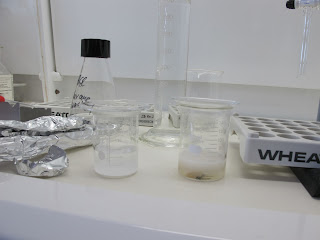 So, by the end of next week, once I've managed to have a look at the results properly, I'll hopefully have worked out which parts of what I want to do work, and which ones don't. Then I can plan ahead and really get going with the actual work!

In the middle of this is three days spent playing with a Chemistry set (a real one!) and another mass spec. I'm going to have to be vague here as the work I'm attempting here has only once been tried before in an unpublished piece of work in this department and obviously I'd rather not get scooped if it turns out to work. Anyway it involves lots of dissolving of my samples in acid, then playing with more chemicals to extract the solute, and all of it has to be done without any contamination, which involves a lot of washing things with yet more chemicals. Its all a bit fiddly but if it works then it may well be really interesting.

Tuesday, 14 December 2010
College

Burgmann is where EG lives, and lies towards the lake end of campus not that far from the department. The blocks he's staying in are self-contained apartments for about five people, with a nice living room/kitchen area, I guess the kind of place that my third-year accommodation was aiming to be! He moved into Burgmann relatively recently and now that its long vac here there aren't too many people around. The colleges tend to lack a sense of community in the way that the Oxford ones did and do, there are only eight main colleges and two grad-only colleges and consequently many people live out for their entire time, or live at home. The Australians are certainly more Scottish than English in their choices of university and moving half-way across the country, partly due to the fact their is no centralised admissions system and so there is an admin fee for every state they apply to uni in.
I guess the community aspect is what made colleges back in Oxford so good and perhaps thats the kind of thing thats missing here. Whenever I visited a college in Oxford (and it was the same here), I tended to feel a bit of regret at not spending more time on site during my undergrad days, I guess it would have been fun. But on the other hand I lived in great houses, so perhaps its just a case of the grass appearing greener and maybe I would have felt a longing to live out had I lived more in, as it were. Afterall, I no longer have to deal with pointless college admin!
Thursday, 9 December 2010
Floods


from www.actewagl.com.au
Its felt drier here the last week, we've even had a couple of nice days, but the ground is sodden, and when the rain arrived again in the middle of this week, it caused widespread disaster across New South Wales, incluing Queanbeyan (which is kind of part of Canberra, but kind of not) whose flood waters peaked at +8m overnight. The town is pretty much split in two and has been declared a natural disaster zone. Tuggeranong (another distant part of Canberra) allegedly received over 100mm yesterday and has topped 400% of its typical December rainfall already. The Queanbeyan sewage works have been flooded too, which means Lake Burley Griffin is out of action due to contamination, so theres been no sailing for the last week. The dam at the end of the lake has all its flood gates open. Other ACT dams are overtopping.
Its going to be an above average cyclone season in the North too.
Rainfall should return to normal levels around April sometime!
Going all sciency it looks like the La Nina conditions are actually weakening slightly, in which case the comparisons to be made are to 74/75. Here's the November SST anomaly map. That is a very warm anomaly surrounding Australia and thats why its raining so much!

from www.bom.gov.au

from www.bom.gov.au
Subscribe to:
Posts (Atom)