Showing posts with label Australian Psyche. Show all posts

Thursday, 21 April 2011

Its not that the Australians don't have history

Its just that they're a bit rubbish at it, and don't really know what to do with it when they have it.

The Australians have this sense of guilt regarding history.  This can be manifested in a guilt as to the lack of it.  Canberra is full of sculptures, public art, an obvious attempt to make up for a lack of history in this young purpose-built town. If you can't have interesting buildings, then at least have interesting spaces.  This is fine and a good thing.  It can be quite fun finding random sculptures dotted around Canberra.  The set of spirit levels running down a hill near the lake is one of my favourites. But Australia does have history.

More often, the guilt is at what happened in the past.  Perhaps more so than other countries, the Australians feel rather guilty about their past.  The past is brutal, there are no all good nations.  Yet young countries like to believe they are, that their country is good. I don't think any Brits are under the impression that our country has been the good guys at all times, though we might believe we had overall good intentions. We know as being part of a 1,000 year old continuous country, that there are probably felons in our heritage, a few dubious characters.  Do we believe that we are partly criminals or have criminal tendancies because of this.  Not really.  Do any of the numerous Lynch's of the world, one of Ireland's more famous family names, believe they have communist revolutionary tendancies because Che Guevara was a Lynch, or at least partly one.

Yet the convict past of Australia still has a certain amount of taboo about it. The Australians feel sensitive about the idea that there is convict dna within them. Maybe this feeling is fading, something that can be joked about more as the number of generations slowly increases. Its still a touchy subject though. When you look back at the numbers of convicts that came to Australia, and the crimes that most of them committed, why is this country sensitive about the idea that maybe one of their great-grandparents came to Australia because they stole a few handkerchiefts (look at the convictions of some of those sent to the Australian prison colonies, some of them aren't for much).  Its not like most of the convicts were murderers or rapists.
This beautiful place is Port Arthur, the prison colony's prison colony's prison colony. A place with a supposedly brutal history. If only they'd tell you about it. Its alluded to, hinted at, but never mentioned, never discussed. This place is where the really bad convicts came, and those who continued to reoffend in Australia.

The biggest idea about who the convicts were came in the form of the political prisoners, some Irish separatists, English chartists and some French-Canadian separatists. (You'll be interested to learn that then as now, being a former convict didn't stop anyone from being in olitical office in later life). Not the juicy stuff.
Perhaps the most brutal part of Port Arthur's history came in 1996. The world's largest gun massacre occurred at this no tranquil site, 35 people were killed, including two children, and 21 injured.  I understand completely how they don't want to bring this up.  Its still fresh, raw and upsetting, the staff still remember it and knew some of those who died.
But I don't quite yet understand why the older stuff is quite so raw. Perhaps it is just a couple of generations too soon.  I guess time will tell.
The Asylum, where everything was bright and breezy according to the museum inside.

Visiting the Olympic stadium and site also highlighted this issue of what Australians do with their history. Whilst still known as the Olympic Park there is hardly any trace left that this place once hosted the Olympics. No Olympic rings, no Olympic flag, no museum, no gift shop. Yet around the entire site, things were happening, all the lesser stadia had people and sports taking place in them. There was a charity cycling event on.  One of the event halls had one of those motivational speaker shows on (the kind where you can improve your life with the power of thought and some colouring pencils) and allegedly a Doctor Who convention (or at least a fan looking for one). The place actually had more bustle about it than some Olympic sites.  In this way the legacy of the olympics is being realised.  There are no (or at least very few) white elephants. But why so few mentions of the Olympics? Lets have a museum please!

The ANZ stadium, not many mentions that this stadium was the centrepiece of what was regarded as the best olympics ever. Lots of stuff about the various footie teams that populate the stadium.
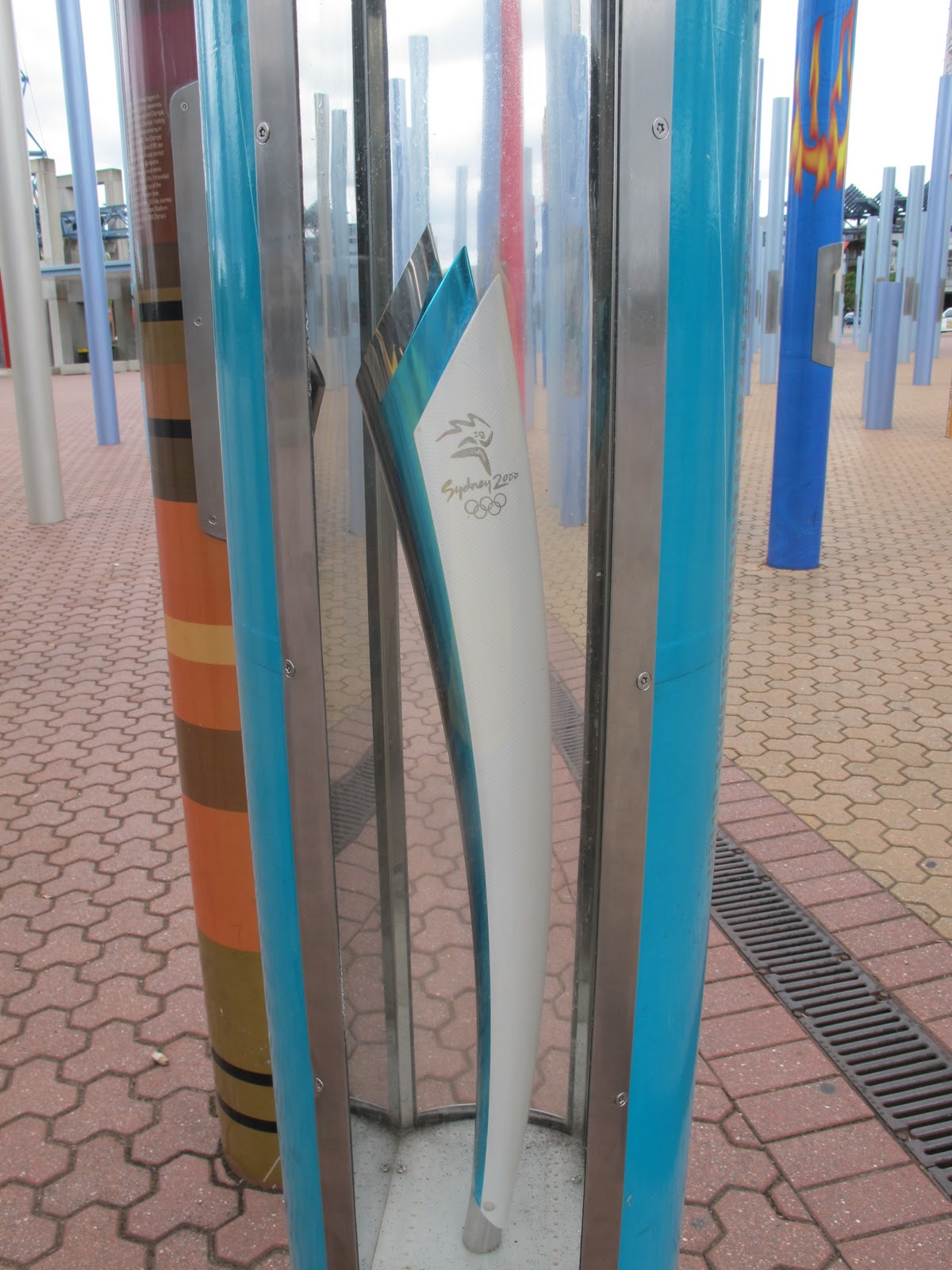
 These poles out the front do at least pay some kind of homage to the Olympics. This being the most interesting one, the Olympic Torch, which is kind of awesome.
 I assume this has something to do with the Olympic Flame, there being a couple of non-descript inscriptions below it.
 And a lake full of algae, with a circular walkway, and a very strong smell of dill.  Is this the Olympic legacy? An integral part of Australian history? The Australians have a lot of history, they just don't quite know what to do with it when they have it.  Instead sweeping it under the carpet and getting on with the here and now.

Tuesday, 29 March 2011

AFL: The Victorian Passion, whether you like it or not.

Aussie Rules football (AFL) is the major sport in Victoria, thats the state at the bottom with Melbourne in. Its given a religious like status, its players gods, its major stadia churches.

Its a strange sport, played on cricket ovals (someone's got to use them in the winter) with similar rules to Gaelic Football (there's an International Rules game, a hybrid of the two played every few years).  It has two sets of posts, so that if you don't score then at least you get a point for trying. Its a high scoring game and draws are rare, though they do happen, as it did in the Grand Final last year. It happens so rarely that they haven't really considered a protocol for what happens when it does, instead having an entire replay for the final match of the season. Again, this is no bad thing, the first Grand Final had just 25,000 tickets for fans of the two teams in a 100,000 seater stadium.  Talk about corporate hospitality. Not even UEFA are that bad.

AFL commentators claim that a draw is the worst result for the players. In some ways thats ridiculous, surely losing is worse.  But they have a point.  The players look so confused when it happens, like they don't know what to do.  They only know winning or losing (as such its a bit of an American sport) and any other outcome is just confusing.  And bless them, its not as if they have many brain cells to try and figure it out.  AFL is a bit of a brutal game, and the number of injuries took up about five minutes of the sports news on Sunday night.

But the thing about the AFL is that they're real assholes. They feel as if they're sport is under attack, that it must be protected at all costs, and damn anyone else, and any other sport. There will be no compromise, the AFL rules over all.  When Australia were bidding for the 2022 Football World Cup, there were huge arguements over whether it would be possible to hold any matches in Victoria, as all the major stadia (such as the iconic MCG) would be being used by the AFL season.  Would they consider altering their schedule, or rearranging games such that at least the MCG could be used.  Not bloody likely.

This year the attendance for the Australian Grand Prix hit a new low, around 280,000 people, down from well over 400,000 in its first year.  Blame this year lay firmly at the feet of AFL, who scheduled their opening weekend at the same time, taking 215,000 fans in five games played in Melbourne.  That's over half a million sports fans attending events in Melbourne over the weekend (1/8th of the population were there no external fans). The organiser of the Grand Prix blamed the AFL and wondered if it might be possible to change the opening weekend of the AFL in future years since the grand prix's place on the calendar is fairly fixed. Asked if he thought this was likely, he laughed.  This point was put to an AFL spokesman, his response "This is Melbourne mate". Arrogance?

The AFL holds sway down south, whether you like it or not.

Tuesday, 1 March 2011

Making people cry

In times of tragedy, like the second Christchurch quake this week, the Australian media delight in a sob story. Obviously they don't take glee in people's death, treating such things with the seriousness it deserves.  But when it comes to other losses, say of property, then the people become fair game for their emotional poking.

Whereas the Brits show stoicism and the Irish have a tendancy to laugh things off the Australian media like people to be really distraught at returning to their homes to find them damaged.  As an unwitting member of the public surveys the damage, grim-faced. Their possessions flood-damaged, their home probably to be destroyed. In comes the probing microphone, the annoying reporter.  Who instead of asking questions such as: "How does it feel?", "What have you lost" instead reals of leading statements, some of them not even questions. Such as "gosh this is terrible, tell us how terrible this is", "how on earth are you going to cope with such tragedy" "this must be the worst thing ever" "tell us exactly how upset you are". They are provoking emotion, trying to get people to cry on camera in order to get a news story.

I don't know whether the Australians view crying as a more responsive news story, especially from blokes, in the machismo aussie culture or whether its just journo hacks being very very low.

The worst example came this week with a reporter interviewing a woman who had returned to her home outside Christchurch having been away at the time of the quake, to find that a giant boulder, at least 5m cubed, had rolled through her house. Obviously she was a bit shocked and teary, so the journalist went in for the kill. "Imagine if your kids had been in the house at the time". You've just lost your house, you're on the verge of tears and the journalist asks you to imagine that your kids were dead. I mean, come on.

It just makes me angry.

Thursday, 3 February 2011

Some thoughts on Australian Nationalism

So with Australia Day firmly out of site in the middle of last week, it seems like an interesting point to talk about the strange creature that is Australian nationalism. Of the group of us that went to the concert and BBQ and fireworks over Australia day only two of us were Australian, one of whom was a girl visiting Canberra from my lab back in Oxford! We're a very international group, though my housemates are all Australian or Kiwi.

Australians are very proud of their nation and what it has achieved. Helping others is a strong part of the Australian psyche, from the State Emergency Services which are run by volunteers and help out during bushfires, flooding, cyclones etc. In the wake of the natural disasters across the country in the last couple of weeks, "helping fellow Australians" has been a common phrase as has the "Aussie spirit".

Being "UnAustralian" is a term bandied around quite a lot, from things as trivial as whether you eat Australian lamb or not on Australia Day to more serious things like looting in Brisbane.  Its quite an interesting concept coming from a place where being unBritish means not queuing properly or apologising profusely for something that isn't your fault. They also take a lot more pride in Australian made produce.  Partly because so much of it is Australian made, especially foodstuffs which is almost all from this country.  Australians almost see it as their duty to buy products made in their country as a way of keeping Australians in business and working.  There's a nationwide community approach in this country that doesn't exist in the UK. Although I've never quite understood why those countries with the strongest national fervour and desire to help their fellow countrymen tend to also be quite conservative in their political views. The "I can give money to help people but the government can't take my money to help people approach" currently being played out by the enormous donations to the Queensland flood appeal combined with the somewhat of an uproar over the idea of a Flood Levy of extra taxes on the wealthy for a single year to cover the costs rather than budget cuts to services or a few extra billion dollars of government debt. Australian politics being as wonderfully spiky as it is has both sides of the arguement calling the other unaustralian!

The Australians have somewhat of a chip on their shoulder, being so out of the way location wise they've always felt they have to stick up for themselves, promote themselves, make some loud noises.  But with the global economy shifting ever eastwards the Australians now find themselves ever more important on the world stage, they've survived the GFC better than most, and now have parity with the US dollar, slowly realising the ups and downs of a strong economy (poorer exports, cheaper imports).

There's been some talk about how the Ashes defeat doesn't mean as much to the nation as previous ones.  Whereas back in the 80s the last time England won down under it was a big event, now the Australians aren't so fussed.  Beating the Poms is now longer such a matter of national pride. Sure its important and the thing the sportsmen aim for, but it doesn't affect the national mood so much.  This country is starting to feel all grown up. Having said that I have heard stories of the consumption of beer in Australia rising and falling with the fortunes of the Australian cricket team, but this may just be an urban myth.

Further to all this there is something of an acceptance of foreigners as being Australian.  As a nation of immigrants, the definition of being an Australian is not something of birth or of race, but of living.  When there were public interviews "Hi, who are you, where are you from, are you having a good time", carried out as part of Australia day, the response towards a couple of foreigners who revealed they had been living in Australia for a couple of years was one of acceptance, of them being an Australian.   Again though this is reconciled with quite a large anti-immigration lobby and sentiments.  Perhaps there remains a touch of unspoken racism lingering on from colonial days when certain ethnic groups were favoured in official immigration policies and later unofficial practices.  But no country is without their contradictions and it would be silly to take too much to task over the combination of welcomeness and political conservatism. Perhaps this is a Canberra thing, which copes with having such a large transient population anyway in students and public students, but I reckon its probably Australia wide.  The sentiments seem to be to bring with you the best of your country and to accept the best of theirs. That having Australian values and living in Australia is what makes you Australian.

I've been here for five months now, I guess it really won't be long before I too am partly an Australian, if I'm not already.